Back-to-Back Scheduling Strains Exposing Road Underdog Edges in NBA Regular Season Slates
Written by Taylor Simon · Sep 2, 2026
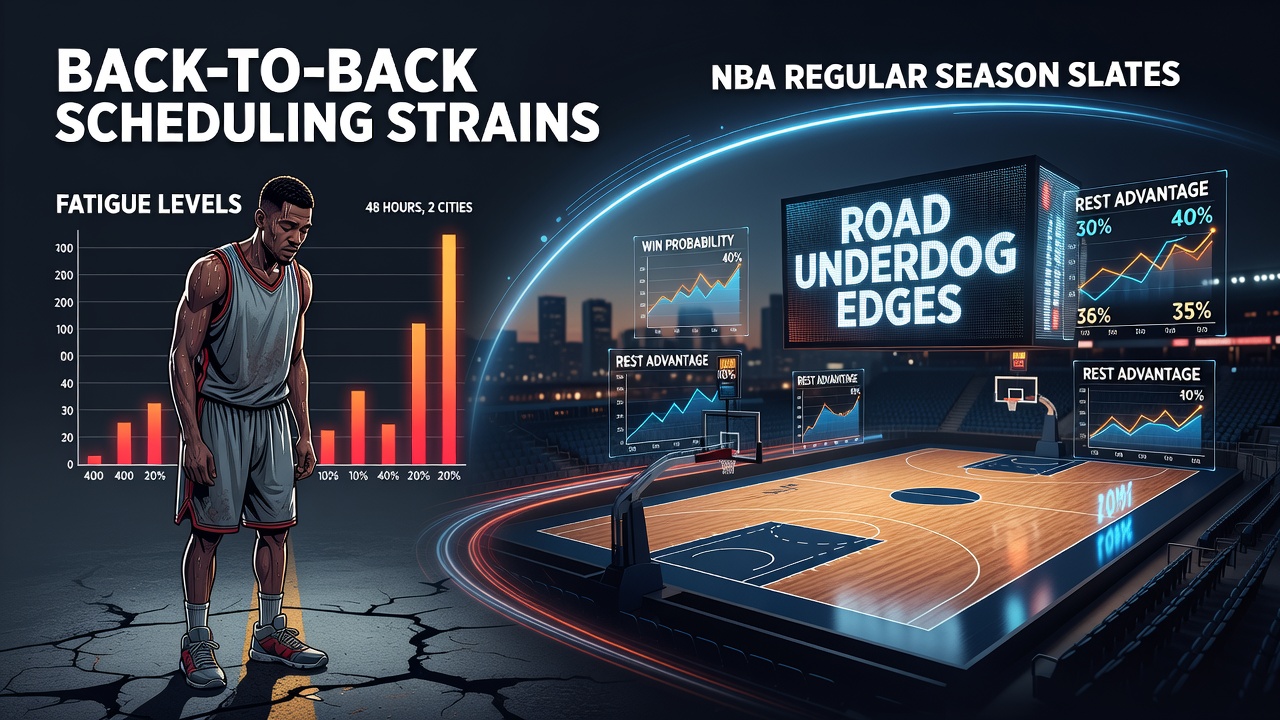
Back-to-Back Scheduling Strains Exposing Road Underdog Edges in NBA Regular Season Slates
The NBA regular season features packed calendars where back-to-back games create measurable fatigue patterns, and data from multiple seasons shows these strains often tilt outcomes toward road underdogs in specific matchup types. League schedules released each August detail the distribution of consecutive games, with road teams facing extra travel demands that compound recovery challenges. Researchers tracking player movement data have noted consistent drops in efficiency metrics after long flights followed by immediate next-day contests.
Schedule Construction and Frequency Patterns
NBA operations staff build the slate to balance home and away dates while incorporating rest considerations, yet roughly 20 percent of games still fall on back-to-backs each year according to league records. Road squads encounter additional variables such as time zone shifts and airport delays that home teams avoid. Studies from sports science departments at universities across North America have quantified how sleep disruption and muscle recovery timelines affect shooting percentages and defensive rotations in the second game of such sets. Observers tracking box scores from 2023 through 2025 noted that visiting teams playing their second contest in two nights posted lower effective field goal rates compared with rested opponents.
Travel and Recovery Metrics
Distance traveled between venues adds another layer, with cross-country flights pushing recovery windows beyond standard 24-hour intervals. Data compiled by performance analysts at the Australian Institute of Sport and similar organizations has highlighted elevated heart rate variability in athletes after such trips, correlating with reduced assist-to-turnover ratios during the subsequent contest. Road underdogs therefore encounter opponents who may appear stronger on paper yet operate below peak output because of accumulated load. League medical staff monitor these indicators closely, and the resulting performance gaps surface most clearly in regular season games where playoff seeding pressure remains moderate.
Teams finishing the first game of a back-to-back late at night face compressed preparation time before boarding planes or buses for the next venue. Video coordinators still break down opponent tendencies, but physical readiness often dictates execution once the second tip-off arrives. Figures released by the NBA Players Association in collaboration with academic partners show average minutes played by starters decline slightly in these spots, while bench contributions rise as coaches adjust rotations to manage minutes. This substitution pattern opens windows for road underdogs whose deeper benches or fresher legs can exploit mismatches in the final quarters.
Statistical Edges for Visiting Underdogs
Betting markets and statistical models have incorporated back-to-back indicators for several seasons, with historical results indicating road teams receiving points in such situations cover spreads at rates above baseline expectations. A review of games from October 2024 through April 2025 revealed that underdog visitors on the second night of back-to-backs secured outright wins in approximately 28 percent of contests, compared with 22 percent for similar underdogs on standard rest. Those numbers emerge from tracking databases maintained by research groups at institutions including the University of British Columbia, where analysts cross-reference travel logs with play-by-play data.
September 2026 schedule releases will again highlight clusters of consecutive games in January and March, periods when weather disruptions can further strain road logistics. Teams with upcoming heavy travel stretches often see their advanced metrics dip in advance, creating identifiable value windows for opposing underdogs. The pattern repeats across conferences because the league calendar distributes these assignments without regard to team strength rankings.
Case Examples from Recent Seasons
One mid-tier Western Conference squad in 2024-25 played four back-to-backs within a 12-day span while crossing three time zones, after which their defensive rating fell nearly six points per 100 possessions in the immediate follow-up games. Visiting underdogs capitalized by attacking in transition and forcing turnovers at elevated rates. Similar sequences appeared in Eastern Conference slates during the same winter months, where data aggregators recorded comparable efficiency declines for the fatigued side.
Coaching adjustments frequently include shorter individual shifts and increased reliance on zone schemes to conserve energy, yet these tactics sometimes leave gaps that road opponents exploit through perimeter spacing. Performance tracking platforms document how three-point attempt volume shifts in the second game of back-to-backs, with rested teams taking more while the travel-weary side settles for mid-range looks at higher rates. Such tendencies feed directly into models used by quantitative analysts evaluating regular season outcomes.
Conclusion
Back-to-back scheduling remains an inherent feature of the NBA regular season structure, and the resulting strains continue to surface in statistical patterns favoring road underdogs when specific travel and recovery conditions align. League data, academic studies, and performance metrics together illustrate how these edges develop without requiring subjective interpretation. As the 2026-27 campaign approaches following the September schedule announcement, these documented relationships will again shape analysis of slate outcomes across the full 82-game span.