Stadium Elevation Changes and Their Effects on Ball Trajectory in High-Altitude Soccer Matches During Evening Fixtures
Written by Taylor Simon · Jun 21, 2026

Stadium Elevation Changes and Their Effects on Ball Trajectory in High-Altitude Soccer Matches During Evening Fixtures
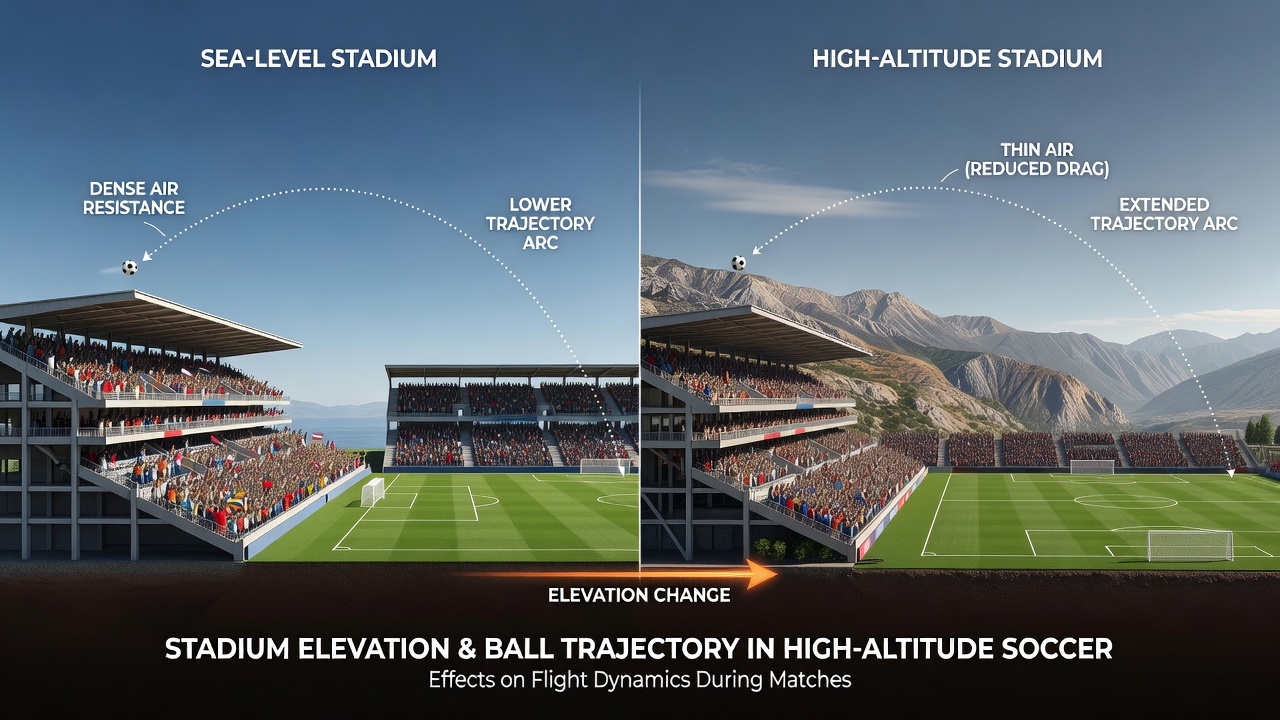
Stadiums situated at higher elevations create measurable shifts in air density that directly influence how soccer balls travel through the air, and these dynamics become particularly pronounced during evening fixtures when temperatures drop and atmospheric conditions stabilize. Researchers studying aerodynamics note that reduced oxygen molecules at altitude decrease drag forces on the ball, allowing it to maintain velocity over longer distances compared to sea-level environments.
Physics Behind Elevation and Ball Flight
Air pressure falls as elevation rises, which thins the atmosphere and reduces resistance against a moving object such as a soccer ball struck at typical match speeds between 60 and 120 kilometers per hour. Studies from atmospheric science programs at institutions like the University of Colorado have quantified these effects, showing that a ball can travel up to 10 percent farther at 2500 meters above sea level than at sea level under identical launch angles and spin rates. The Magnus effect, which governs curved trajectories from spinning balls, also weakens because fewer air particles interact with the ball's surface, resulting in passes and shots that dip less sharply after reaching peak height.
High-Altitude Venues and Documented Patterns
Venues such as Estadio Hernando Siles in La Paz at approximately 3600 meters and Estadio Azteca in Mexico City near 2240 meters have hosted numerous matches where trajectory data collected via tracking systems reveal consistent deviations from lower-elevation norms. FIFA match reports indicate that long-range attempts clear defensive lines more frequently at these sites, while goalkeepers adjust positioning because balls arrive with less downward arc during evening hours when surface cooling reduces thermal updrafts. Players and analysts observe that crosses from the wings often overshoot targets unless adjusted for the thinner air, prompting teams to favor shorter, ground-based combinations instead.
Evening Fixture Variables
Temperature declines of 8 to 12 degrees Celsius after sunset further cool the air mass above pitches, increasing its density slightly yet still leaving overall drag lower than at sea level. Wind patterns in mountainous regions often settle during twilight, minimizing cross-breezes that could otherwise compound or counteract elevation-driven flight changes. Data from multiple Copa America encounters in June 2026 demonstrated that evening matches at elevated stadiums produced higher average pass completion rates for through balls because the ball's straighter path allowed midfielders to exploit spaces behind retreating defenses more effectively.
Player and Tactical Adaptations
Coaches prepare squads by conducting training sessions at comparable elevations weeks before travel, allowing muscle memory to recalibrate for the altered flight characteristics. Goalkeepers in particular drill reactions to flatter, faster-approaching shots that lose spin-induced movement, while strikers practice striking through the ball with reduced loft to prevent over-hitting. Video analysis from CONMEBOL competitions shows that set-piece routines shift toward low-driven deliveries because aerial balls become harder to control precisely in the thinner evening atmosphere.
Equipment and Environmental Interactions
Ball manufacturers test products under varied pressure and humidity conditions to meet standards set by organizations including the International Football Association Board, yet match balls still exhibit distinct behavior once exposed to real altitude gradients during play. Evening dew formation on pitches adds minor surface friction that can slow rolling passes, offsetting some of the airborne distance gains from reduced drag. Observers tracking multiple fixtures note that these combined factors create predictable windows where teams accustomed to lower elevations initially struggle before adapting within the first 20 minutes of each half.
Measurement Technologies and Data Collection
Optical tracking systems deployed by leagues and federations capture three-dimensional ball paths at 60 frames per second, generating datasets that researchers cross-reference with meteorological readings from nearby weather stations. These records confirm that launch angles between 15 and 25 degrees produce the greatest distance differentials at altitude, while higher-angle chips lose relative advantage because gravity dominates once drag drops. European Space Agency-supported atmospheric models have been applied to simulate these conditions, helping analysts predict how evening fixture schedules might influence match statistics across different tournament phases.
Conclusion
Elevation-induced changes in ball trajectory during evening soccer matches follow consistent physical principles that teams and analysts incorporate into preparation and in-game decisions. Continued data collection from high-altitude venues refines understanding of these interactions and supports more accurate performance forecasting across competitions.